Vladimir Bashkirov
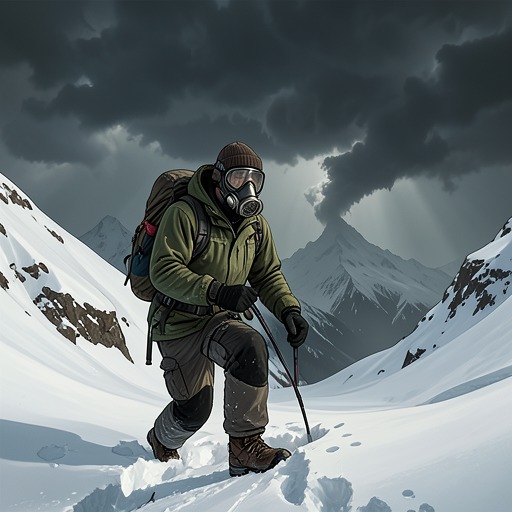
The ClimbVladimir Bashkirov was a Russian high-altitude mountaineer, expedition adviser, and trusted friend of Anatoli Boukreev whose career joined technical distinction to practical service. Recruited for the 1997 Indonesian National Everest Expedition, he helped keep its exhausted summit team alive through a precarious night at Camp V. Soon afterward, he died on Lhotse after reaching its summit without supplemental oxygen, a loss that turns the expedition’s account of teamwork into a memorial to the limits of rescue.
Identity and Background
Boukreev recruited Bashkirov as one of two Russian mountaineers advising the Indonesian expedition. At forty-five, Bashkirov brought more than fifteen years of experience organizing expeditions to remote areas, technical expertise on the great walls of the Pamirs and Caucasus, and six successful summit attempts on peaks above 8,000 meters, including two on Mount Everest. His credentials made him a substantial high-altitude resource; his manner made him a counterweight to Boukreev’s difficult personality.
Boukreev described Bashkirov as soft-spoken and diplomatic, with a good command of English and the personable communication skills and judgment the expedition needed. He was also an adventure cameraman and filmmaker in Russia, and was to record the expedition for the Indonesians. His role therefore joined technical advising with communication and documentation, rather than being confined to climbing.
Work on the Indonesian Expedition
Bashkirov’s work unfolded within an expedition conscious of organizational weakness. Its leader wanted experienced staff capable of working with or without oxygen and of contributing to high-altitude rescue. The Indonesian team’s Sherpa workforce was uneven: only eight of sixteen were considered fit to function, threatening both the summit plan and its backup safety arrangements. Boukreev did not blame individual workers, noting that a strong, skilled Sherpa team took years of repeated ascents and consistent financial support to develop. Bashkirov’s experience and judgment were consequently part of a broader effort to make the expedition’s support more dependable.
The expedition’s acclimatization proceeded through successive camps and rests. After reaching Camp III at 7,300 meters, the Indonesian climbers later made their summit attempt and arrived at Camp V at 7:30 in the evening. Their emergency shelter was missing two sections of its poles and functioned more like a large bivouac sack than a properly equipped tent. Six people crowded inside with a stove, pots, gas, a sleeping mat, and two full oxygen bottles. The summit had been reached, but the group still faced a night at altitude with its members exhausted and the descent unfinished.
Camp V and the Work of Rescue
Boukreev’s account calls the night dramatic, while emphasizing its practical labor rather than a single heroic gesture. Evgeny Vinogradski immediately began heating water and continued through the night. Bashkirov and Boukreev took turns changing the oxygen mask among three exhausted Indonesian summiters, rationing the limited supply so it would last. When one climber had gone too long without the bottle, he would cry or pray. Bashkirov’s contribution was sustained, shared care: he worked quietly in rotation with Boukreev and Vinogradski, helping the group endure until morning.
At dawn, the team emerged into calm weather and clear views of Lhotse, Makalu, and Kanchenjunga, with sunlight on Everest’s summit. The climbers were out of oxygen, but the Indonesians had acclimatized and had spent the night gradually weaning themselves from the bottle. They were moving slowly, yet able to descend; no one had frostbite. The account makes the night’s outcome conditional rather than triumphant: reaching the summit would count as a true victory only if the members made it back to Base Camp. Bashkirov’s work helped make that safe return possible.
Death on Lhotse and Memorial
Bashkirov’s own final climb came soon after. On May 26, the planned Lhotse–Everest traverse with Simone Moro was abandoned after Bashkirov and Moro summited Lhotse alongside eight members of a Russian team that included Bashkirov. He climbed without supplemental oxygen. After reaching the summit, he collapsed from altitude sickness. Boukreev radioed the Russians’ highest camp for oxygen, and two Russians immediately set out uphill with emergency supplies, but they arrived too late. Bashkirov died on Lhotse.
The narrative places his death beside the Camp V rescue, but does not turn that contrast into a claim that the same outcome could have been prevented. On Everest, Bashkirov had helped distribute scarce oxygen and preserve exhausted climbers through a night; on Lhotse, an urgent call brought rescuers uphill, yet not in time. The memorial passage remembers mountaineers who do not return from the summits and gives Bashkirov’s death a place within that larger community of lost friends. His story thus holds together both the discipline of collective care and the mountain’s power to make even a rapid response arrive too late.